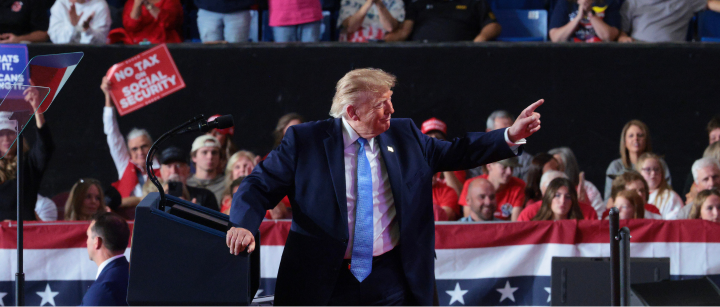
Throughout October, President Donald Trump has traveled across the country, holding campaign rallies supporting Republican candidates in the 2026 midterms. He has several more rallies scheduled before Election Day on Nov. 3.

In his remarks, which tend to last more than an hour, he has mostly boasted about his and Republican policies, while attacking some Democrats running for office and others who are not. Along the way, the president has made a number of false, misleading or exaggerated claims, many of which will be familiar to our readers.
Here are more than a dozen of his rally claims that we flagged, including statements about the economy, crime and immigration. He repeated nearly all of these claims during multiple campaign stops.
Economy
Inflation: In Syracuse on Oct. 9, Trump falsely claimed that he “inherited the worst inflation in American history,” then added, “Now we have it down to 1.8%.” The worst inflation occurred after World War I, when the 12-month increase in prices was 23.7% from June 1919 to June 1920. The annualized inflation rate during the Biden administration peaked at 9.1% in June 2022, and was down to 3.0% when Trump took office in January 2025. It was most recently up to 3.7% for the 12 months ending in September.
It’s unclear how Trump calculated 1.8% inflation. He said it referred to “core inflation,” and in other instances used 1.7% and said this was over three months. That’s also wrong. Core inflation, which refers to the rise in prices excluding food and energy items, was 2.6% for the 12 months ending in September. That is down from the 3.3% annual core inflation rate Trump inherited, but the annual rate hasn’t been 1.7% or lower since 2021.
Oil prices: While talking about the Iran war during his Syracuse rally, Trump said: “As soon as the war is over, oil is tumbling down like you’ve never seen. It’s already coming way down. We control the strait. Oil is coming down.” The price of crude oil is not “way down.” West Texas Intermediate crude, which is the U.S. oil benchmark, was $98.73 a barrel on Oct. 9, and was up to $105.25 as of Oct. 26, according to Energy Information Administration data. The price was $66.96 a barrel on Feb. 27, the day before the war with Iran began. Meanwhile, the price of Brent crude, the international oil standard, was $130.03 on Oct. 9, up from $71.32 just before the war. It was $128.12 as of Oct. 26. It’s unknown how fast oil prices will fall when the war ends. Analysts told us in May that it could take many months before the price of gasoline, which is influenced by oil prices, is back to the pre-war national average of $2.94 per gallon.
Poverty: Trump said in San Antonio on Oct. 7: “The poverty rate has just reached its lowest level, so the best poverty numbers, lowest level in American history. Think of that. African American poverty, Hispanic American poverty, and Native American poverty rates are all at their lowest levels ever recorded.” Trump is right about the official poverty rate, but an alternative measure isn’t at its lowest level.
The official U.S. poverty rate was 10.2% in 2025, the lowest on record, according to estimates the Census Bureau released in September. The official poverty rates for Hispanics and Native Americans also reached record lows last year. The lowest rate for African Americans was 17.1% in 2022 (see Table 3).
But 2025 was not a record year based on the supplemental poverty measure, which factors in government assistance programs that help low-income households, such as food and housing assistance, and accounts for geography and additional expenses not covered in the official poverty measure. By that measure, 13.1% of the U.S. population was living in poverty in 2025, which was higher than the low of 7.7% in 2021, during the COVID-19 pandemic, as well as the pre-pandemic low of 11.7% in 2019. Poverty for African Americans, Hispanics and Native Americans was also lower in previous years using the SPM (see Table 8).
More people working. “More Americans are working today than at any time in the history of our country,” Trump said in Port Huron, Michigan, on Oct. 25. This has been a staple of Trump’s speeches for more than a year, and, while accurate, there’s less to it than it may appear. According to the Bureau of Labor Statistics, there were 159,044,000 people working in the U.S. in September. That’s more than ever before. But the U.S. also has its largest population now. The employment-to-population ratio, which was 59.2% in September, is down from 60.1% when Trump took office for his second term in January 2025.
Economic growth: In Youngstown, Ohio, on Oct. 12, Trump said, “Our first term was phenomenal. You know, we had the greatest economy in the history of our country. We’re blowing it away now.” But neither of Trump’s terms were the “greatest” in terms of growth of real (inflation-adjusted) gross domestic product, the measure favored by economists. During Trump’s first term, annual real GDP growth peaked at 3% in 2018, according to the Bureau of Economic Analysis. Since he has been back in office, real GDP growth was just 2.3% in 2025 and was also less than 3% in the first and second quarters of 2026. Dating back to the Reagan administration, real economic growth has exceeded 3% annually 16 times.
Investing in America: In Clarksville, Tennessee, on Oct. 10, Trump exaggerated when he said, “We have $21 trillion being invested in our country, more than at any time, for any country anywhere in the world.” Trump has never provided a full accounting for this inflated claim. The White House website only claims $11.2 trillion “in new investment in America, and counting,” as of Oct. 22. As we’ve written, much of that “investment” is based on announcements from companies and countries that experts told us are speculative and may never happen. And many of the announcements are routine expansion plans and have nothing to do with Trump’s policies.
Factories. In San Antonio, the president said, “We have more factories being built right now than at any time in the history of our country,” a claim he has made repeatedly. There’s not one source of information showing how many factories have been under construction at any given time over U.S. history. But U.S. Census Bureau data on manufacturing construction spending contradict Trump’s claim. Spending to build or rehabilitate manufacturing sites has declined since late 2024. The quarterly and monthly figures continue to show this trend since we wrote about the issue in February. The decline is expected to continue in 2027, according to a biannual survey conducted by the American Institute of Architects.
Benefits
Medicare checks. Trump claimed in Syracuse that his administration “has also located billions and billions of dollars that were supposed to be spent on improving Medicare, but they never spent it. So instead, they wanted to hide it.” He added that more than 20 million seniors would “receive a check for a minimum of $100 each because I found all that money.” But that money was never hidden. Trump is referring to a fund Congress created in 2008 to pay for improvements to Medicare. The size of the fund has varied over the years as Congress has added to it or taken money out, but the Centers for Medicare & Medicaid Services has never spent any of it. CMS says the payments to beneficiaries are $90 each, not “a minimum of $100,” as Trump said. Those payments will deplete most of the roughly $2 billion that had been in the fund, according to the health policy research organization KFF.
$5,000 checks: In Park City, Kansas, on Oct. 19, Trump said, “If Republicans win the House of Representatives and the U.S. Senate, I am going to give all adult citizens in the United States of America $5,000.” He said this would be possible because “we’re taking in massive amounts of money through tariffs and many other record-setting economic things.” Paying that much to the more than 245 million U.S. citizens 18 and older would cost around $1.2 trillion. Tariff revenue has increased under Trump, but is still less than $200 billion a year. “It would take 6+ years of tariffs to fund one year of these checks,” Marc Goldwein, senior vice president and senior policy director at the nonpartisan Committee for a Responsible Federal Budget, told us.
Tax cuts. In Greenville, North Carolina, on Oct. 20, Trump boasted that the One Big Beautiful Bill Act that he signed on July 4, 2025, “gave you no tax on tips, no tax on overtime, no tax on Social Security for our great seniors.” As we have written, the law did not eliminate all taxes on tips, overtime pay and Social Security. The exclusion on tips, for example, is limited to qualified tips up to $25,000 and begins to phase out when modified adjusted gross income exceeds $150,000 for a single filer. The overtime exclusion also hits income limits. And the Social Security provision — actually a tax deduction of $6,000 for those age 65 and older whether they get Social Security benefits or not — phases out for those earning $75,000 or $150,000 for couples filing jointly. Moreover, all three provisions expire after 2028.
He misleadingly added that “every single Dumocrat in Congress” voted against all three provisions. As we have written, however, while no Democrat voted for the OBBBA, many said they supported the tax cuts on tips, overtime and for seniors — and would work to make them permanent — but opposed the larger bill for other reasons — chiefly that overall tax cuts were skewed to the wealthy, and that the legislation cut funding to Medicaid and reduced spending on federal food benefits.
Prescription drug prices. Also in North Carolina, Trump said, “And under my most favored nation agreement on drug prices, we went from paying the highest drug prices anywhere in the world just a few months ago … to the lowest drug prices anywhere in the world — with price differences of 300 percent, 400 percent, 500 percent, 600 and even 700 percent.” Setting aside the mathematical ridiculousness of drug prices dropping by 300% to 700% (in which drug companies would be paying customers instead of the other way around), the claim about Americans paying the lowest drug prices in the world is exaggerated. As we have written, Trump’s efforts may have lowered prices for some consumers buying certain drugs. But there isn’t evidence the deals so far have led to broad decreases in drug prices, and experts told us there’s no guarantee of substantial savings for Americans in general in the future.
Crime
Violent crime: In San Antonio, Trump said, “Together we achieved the largest drop in violent crime ever recorded, despite the people coming in that we didn’t want.” Then he added, “And remember, we got most of those hardcore criminals out.” As we’ve written, FBI data show the 2024-to-2025 decreases in both the violent crime rate (9.7%) and the murder rate (18.5%) were the largest one-year declines going back to 1936. That’s not all due to Trump, as violent crime has been falling for the past several years since a spike during the 2020 pandemic. Also, in a September report written by the University of Wisconsin’s Michael T. Light for the Council on Criminal Justice, Light said it was difficult to link a decline in homicide to immigration enforcement, since homicide began decreasing before the 2025 surge in enforcement, which “disproportionately targeted nonviolent immigrants.” Light said that “homicides declined across states regardless of their cooperation with federal immigration authorities.”
Drug smuggling: In Sioux City, Iowa, on Oct. 22, Trump made the unsupported claim that “we brought the flow of deadly drugs coming in by ocean … down by 97%.” As we wrote in June, it’s not possible to know if his claim is accurate because there is no comprehensive data on all drugs trafficked to the U.S., including the amount not seized by officers. Administration officials told other fact-checkers that the president’s claim is based on seizure data comparing the amount of drugs seized by CBP’s Air and Marine Operations in July 2025 to November 2025. That’s cherry-picking. The amount of seized drugs is used by some as a proxy for how much enters the country in total. But using July — which saw a huge one-month spike in drugs seized — as a starting point made the change in drug seizures during Trump’s second term look like a much larger decline.
Immigration
Illegal immigration: When criticizing the Biden administration in his Youngstown remarks, Trump said: “They allowed 25 million people to pour across our borders from all over the world. They came from prisons. They were drug dealers. They were rapists. They were murderers, 11,888 murderers, half of whom committed more than one murder. And they poured in here totally unchecked, totally unvetted.”
As we’ve written, Trump’s inflated 25 million figure is more than double the number of people caught crossing the border illegally (7.3 million, which includes repeat offenders), people who showed up at legal entry ports without authorization (1.2 million), and people estimated to have evaded capture (2 million) under the Biden administration. And after those initial encounters, 2.9 million were removed by CBP, and 3.2 million were released with notices to appear in immigration court or report to Immigration and Customs Enforcement or given parole or other classifications.
Also, immigration experts told us there’s no evidence that other countries released large numbers of inmates and then sent them to illegally immigrate to the U.S., as Trump has repeatedly claimed since 2024 without substantiating it. As for 11,888 murderers, that refers to the number of noncitizens in the U.S. — including those with legal status — who had been convicted of murder but were not in ICE custody as of September 2024. DHS previously told us that the “vast majority” entered and had their custody status determined prior to the Biden administration and that many were in prison.
Zero admissions. In Perry, Georgia, on Oct. 24, Trump said, “In the past 17 months, zero illegal aliens have been admitted to the United States.” What Trump likely means, as U.S. Customs and Border Protection highlighted in an Oct. 16 press release, is that there have been no releases at the southern border, meaning no one caught crossing the border illegally was temporarily released into the U.S., for example, to apply for asylum. On his first day in office, Trump enacted a policy effectively barring asylum applications. It does not mean that no migrants are attempting to cross the border illegally, or that none of them are successful in doing so. Over the last 17 months, about 5,000 to 10,000 migrants have been apprehended attempting to illegally cross into the U.S. every month by Border Patrol agents (far fewer than were apprehended each month under President Joe Biden). As we have written, while CBP does not regularly report on the number of so-called gotaways, immigrants who are detected via electronic surveillance crossing the border but evade apprehension, CBP has acknowledged thousands have occurred.
Other Claims
Climate change. Trump wrongly suggested that climate change isn’t real and that the world is getting cooler, as he has before. In Youngstown, he referred to a 2018 climate report and said that “we had a lot of cooling and the ice is now bigger than it’s ever been, for some reason. It grew a lot.” He went on to falsely claim that “the word ‘warming’ didn’t work” so the term “climate change” is now used instead. Global average temperatures have been rising for decades, with all 10 of the warmest years on record occurring since 2015. It’s unclear which ice Trump is referencing, but Arctic sea ice and ice sheets such as Greenland and Antarctica have all been losing ice over time, as data collected by NASA show.
Ending wars: In Michigan, Trump claimed, “I settled eight wars. No other president settled a war.” We’ve written before that experts in international relations have credited Trump with playing a key role in ending fighting in four conflicts. Trump also counts some international disagreements that weren’t wars, as well as some battles that haven’t officially ended. In addition, it’s not accurate that no other U.S. president helped end a war. As CNN has noted, Presidents Theodore Roosevelt, Jimmy Carter and Bill Clinton each helped broker peace agreements between nations at war.
2020 election: When talking about the 2020 presidential election in Iowa, Trump falsely claimed: “They cheated us on the second one because we won it three times. … They cheated. They rigged the election.” Trump has never proved his baseless allegation that Democrats cheated to win in 2020. Biden received more than 81.2 million popular votes to Trump’s 74.2 million, and Biden won 306 electoral votes to Trump’s 232. In referring to Republicans’ SAVE America Act, Trump went on to say that Democrats “voted against voter ID because they want to cheat” and “voted against proof of citizenship because they want to cheat.” But opposing the legislation doesn’t mean that Democrats want to cheat during elections. Some Democratic lawmakers have opposed the voter registration and identification bill, which includes several other provisions, because they say it could make it much harder for millions of citizens to vote.
Clarification, Oct. 28: In our item about violent crime, we clarified that a September report we cited was written for the Council on Criminal Justice by the University of Wisconsin’s Michael T. Light.
Editor’s note: FactCheck.org does not accept advertising. We rely on grants and individual donations from people like you. Please consider a donation. Credit card donations may be made through our “Donate” page. If you prefer to give by check, send to: FactCheck.org, Annenberg Public Policy Center, P.O. Box 58100, Philadelphia, PA 19102.
The post FactChecking Claims from Trump’s Midterm Rallies appeared first on FactCheck.org.

